
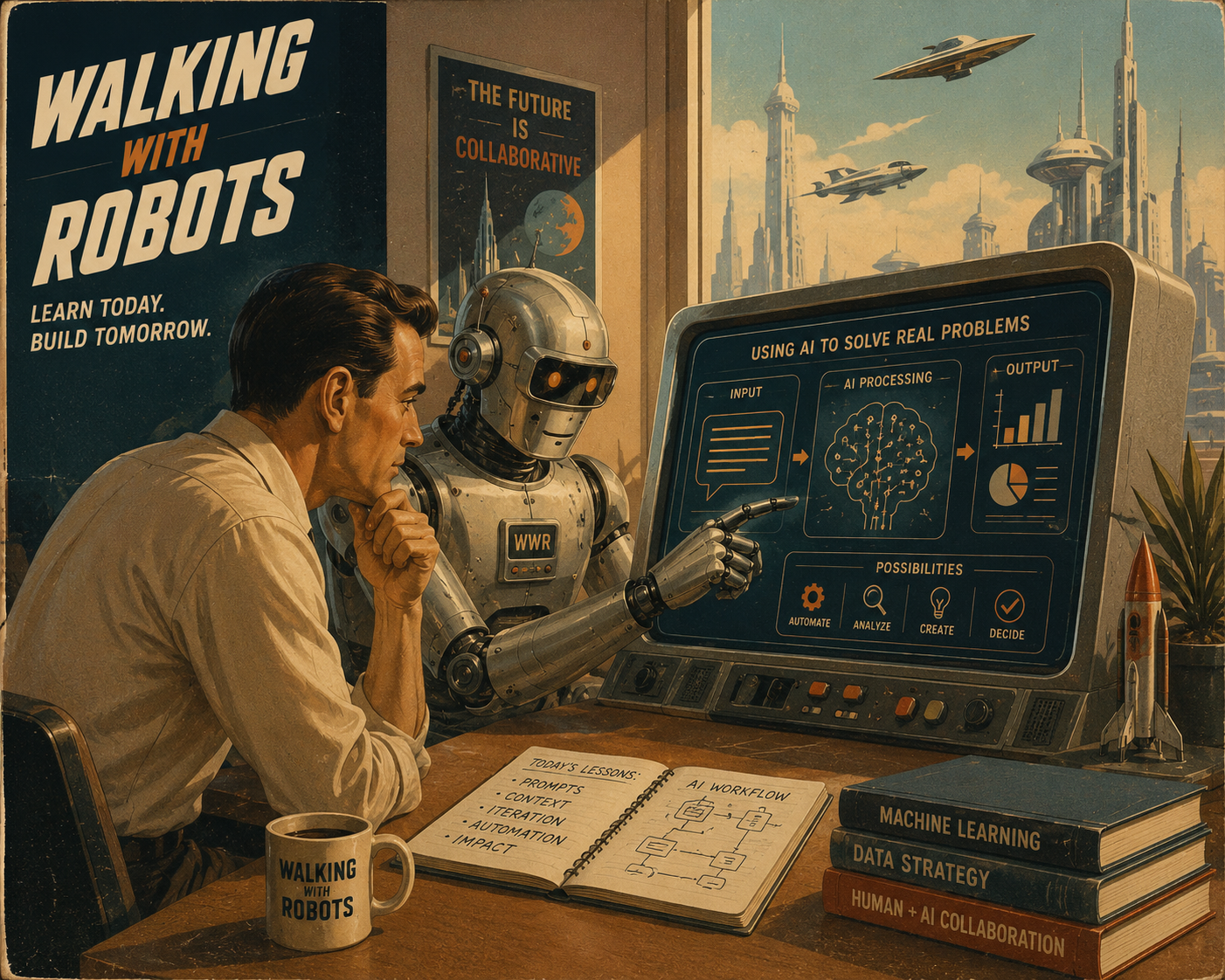
A couple of months into Walking With Robots, at least one thing is clear. The premise holds.
Almost every conversation I have lands in the same place: organisations can see the potential of AI, but they still cannot translate it into meaningful change across day-to-day work.
That matters, because it means the problem is real. The harder question comes immediately after that: in a world full of AI products, consultants and training courses, why Walking With Robots?
Fair question.
Honestly, I think the answer sits in the overlap between two very different arcs of my career.
The first is the recent one. For the last couple of years I have spent an enormous amount of time inside these tools: Claude, Claude Code, Codex, OpenClaw, agents, workflows, prompting patterns, and the wider landscape around them. Not as a developer, but as a knowledge worker trying to understand what this shift actually feels like from the inside.
That distinction matters to me. The point is not that I can use developer tooling. Plenty of people can. The point is that I have learned what these systems change for someone who is not technical, because that is the perspective I came in with myself.
The second arc is everything before AI became the centre of the conversation: marketing, operations, customer experience, product, technology, client-side, agency-side, start-up and enterprise. Years spent inside organisations, close to the problems leaders are actually trying to solve.
Neither side is enough on its own.
The AI experience without the business context creates people who are fascinated by the tools but cannot see where they genuinely matter. The business context without the AI depth creates strategy people who still do not really understand what is now possible.
The value is in the overlap. And the discipline, for me, is staying there.
It is much easier to wander to either end of the spectrum: deep in the tools, or high above them. The harder work is staying connected to both.
But I increasingly think the gap between those two worlds is exactly why so much AI adoption still disappoints people.
Walking With Robots is a deliberate decision to stay in the murky middle and help create clarity.